
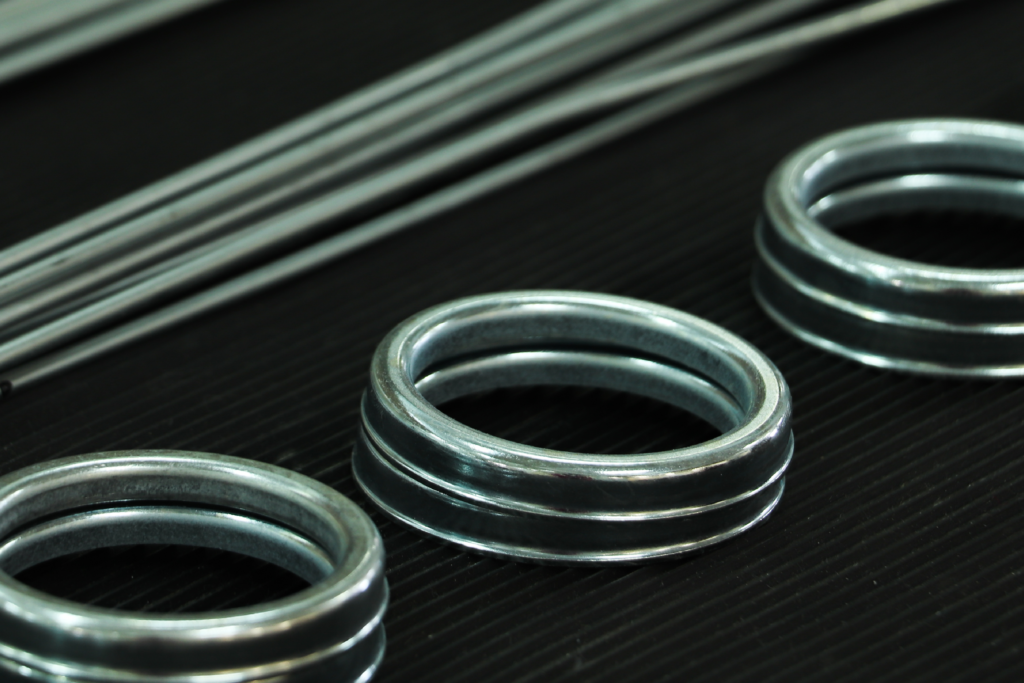
In the design of mechanical systems, one of the most common challenges is ensuring the axial positioning of components mounted on shafts or housed within cylindrical cavities. A widely used technical solution to this challenge is retaining rings.
Retaining rings, also known as retaining rings, snaprings, or circlips, are precision metal components designed to be secured within machined grooves, acting as axial stops that prevent unwanted movement of parts during system operation.
At RYPSA, we manufacture retaining rings (O-rings) with tight tolerances and high-performance materials for automotive, industrial, and home appliance applications.
What is a retaining ring, and how does it work?
A retaining ring is a circular fastener, typically made of spring steel, that is installed inside a machined groove on a shaft (shaft ring) or inside a housing (housing ring).
Once installed, the ring uses its elastic tension to hold itself in place within the groove, creating a rigid axial stop that secures the adjacent component.
Its key features are:
- Quick installation without complex tools
- High resistance to axial loads
- Lightweight and compact
- Compatible with automated assembly processes
The Most Common Types of Retaining Rings Used in Industry
There are different types of thrust rings depending on the geometry of the system in which they are installed and the axial load they must withstand:
- Shaft collars (external): installed in the outer grooves of shafts and axles
- Inner bearing rings: These are placed inside cylindrical cavities to retain bearings, bushings, or other components.
- Spiral rings: They provide a larger contact area and are used in high-load applications
- Retaining rings with tabs: make installation and removal easier using specialized pliers
Selecting the appropriate type depends on the diameter of the shaft or housing, the available groove depth, and the maximum expected axial load.
Applications of Retaining Rings in the Automotive Industry
In the automotive industry, retaining rings are components found in many vehicle systems.
Among the most common applications are:
- Automatic and Manual Transmissions
- Steering Systems
- Drivetrain Axles and Shafts
- Gearboxes
- Suspension Mechanisms
In all of these systems, the failure of a retaining ring can cause critical components to shift, affecting the vehicle's safety and performance.
Manufacturing and Quality Control of O-Rings at RYPSA
At RYPSA, we manufacture retaining rings from high-quality spring steel, with rigorous dimensional control in every production batch.
Our processes include:
- Cold-formed using high-precision machinery
- Heat treatment to ensure elasticity and fatigue resistance
- Verification of critical dimensions: clear diameter, width, and thickness
- Batch-by-Batch Retention Force Control
- Automated visual and dimensional inspection
These checks ensure that each ring maintains its retaining function throughout the system's service life.
Conclusion
Although small in size, retaining rings play a critical role in the assembly of mechanical systems, ensuring the axial positioning of components under load and vibration.
At RYPSA, we manufacture retaining rings with the precision and reliability required by the automotive industry and other high-performance industrial sectors.
Continue reading
- Technical Specifications: Arillos
- Industry: Automotive