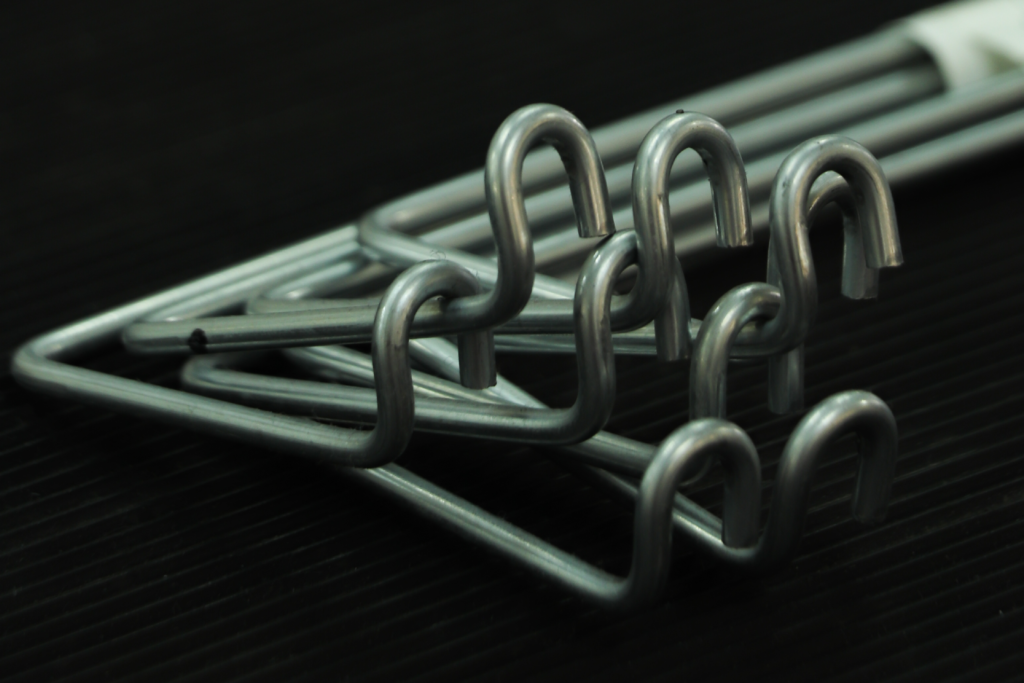
A vehicle seat is one of the most complex systems in the automotive industry. Behind its final appearance, it incorporates dozens of components that work together to provide comfort, structural support, and safety to the occupant over thousands of hours of use. Within that system, wire forms for automotive seats play a fundamental technical role: they are the structure that supports, guides, and shapes the assembly.
At RYPSA, we design and manufacture wire forms specifically to meet the demanding requirements of the automotive industry, ensuring ergonomics, structural strength, and durability in every part we produce.
What is the purpose of the wire shapes in a car seat?
A modern automotive seat consists of a metal frame, comfort foams, adjustment systems, and fabric or leather upholstery. Wire forms are used at multiple points in this system:
- Backrest support structure: wire frames that define the geometry of the backrest and support the occupant's weight
- Cushion supports: components that distribute the load across the seat foam and prevent permanent deformation
- Foam guides and retainers: components that keep the comfort elements in place within the seat
- Internal fasteners: components that connect the seat's subsystems to one another with the proper stiffness and flexibility
- Adjustment system components: shaped wire that allows for controlled movement of seat parts
Each of these parts must meet strict dimensional tolerances and maintain its mechanical properties throughout the vehicle's service life, under conditions of vibration, temperature, and repetitive loading.
Materials Used in Wire Forms for Seating
The selection of materials is a critical technical decision that determines the structural strength, flexibility, and service life of each wire form. At RYPSA, we work with materials that comply with American, European, and Japanese standards, in round or rectangular cross-sections depending on the requirement:
- Low-Carbon Steel (SAE 1008-1010-1018): for structures that require formability and weldability without sacrificing basic strength
- Hard Drawn (ASTM A227): superior mechanical strength for moderate loads with high cycle usage
- Music Wire (ASTM A228): Maximum fatigue resistance for components subjected to intense cyclic loads
- Oil-Tempered (ASTM A229): excellent mechanical strength for applications involving sustained high loads
The available finishes comply with the automotive industry's environmental standards and can withstand up to 1,000 hours of salt spray testing, including zinc, nickel, phosphate, Delta-Tone, e-coat, and rust prevent, among others.
Manufacturing Technology: Specialized Machinery for Complex Geometries
Wire forms for automotive seats typically have complex three-dimensional geometries that cannot be manufactured using conventional equipment. At RYPSA, we use a variety of specialized manufacturing processes for these types of products:
- Four Slide: for wire shapes with multiple bends in different planes
- Multislide: Greater Flexibility in Complex Geometries with Multiple Simultaneous Operations
- Double-Head Wire Benders: Bilateral bending for high-precision symmetrical shapes
- 3D Wireforming: Three-dimensional forming for highly complex seat geometries
- CNC Multi-Forming Machines: Precise Programming for Shapes with Critical Tolerances and High-Volume Production
In addition, we offer secondary processes such as welding, stamping, and special cuts that allow us to integrate multiple operations into a single part without the need for additional assemblies.
Dimensional accuracy: the standard required by the automotive industry
In the manufacture of automotive seats, a wire shape that is out of tolerance can cause assembly problems, structural noise, or deformation of the comfort system. That is why at RYPSA we apply rigorous dimensional controls supported by specialized measuring equipment.
Our processes ensure dimensional accuracy, repeatability, and quality in every part, from the first prototype to mass-production runs, in accordance with the IATF 16949 quality standards that govern our operations.
We work with wire diameters ranging from 0.254 mm to 10 mm, and thanks to the flexibility of our machinery, we are able to handle projects of low, medium, and high volume.
Conclusion
Wire forms for automotive seats are structurally critical components that directly impact the comfort, safety, and durability of the seating system.
At RYPSA, with more than 50 years of experience as a 100% Mexican company, we manufacture these parts using the right materials, the appropriate technology, and the quality control standards required by the global automotive industry.
Continue reading
- Technical Specifications: Wire Shapes
- Industry: Automotive