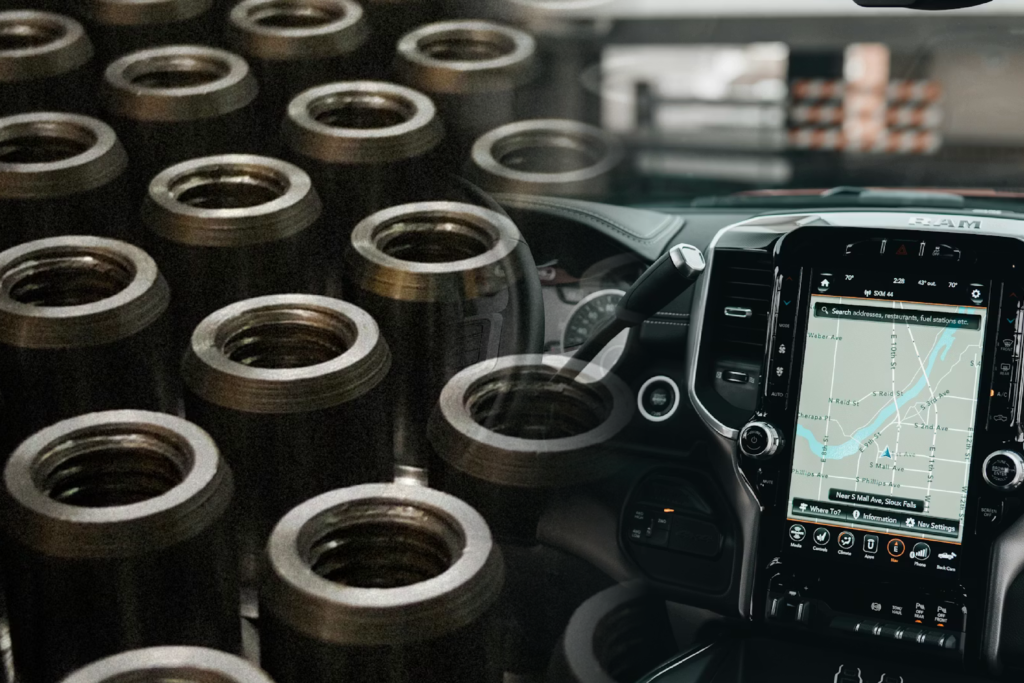
In any mechanical system involving relative motion between parts, controlling friction and damping vibrations are critical factors for the durability of the assembly.
Metal bushings in automotive systems serve exactly that purpose: they act as support, guide, and friction-reducing elements between components that move relative to one another, protecting the integrity of the system.
Although they are usually small, a poorly designed hub or one manufactured outside of tolerance can compromise the performance of high-value components such as suspensions, steering columns, or drivetrains.
What is a metal hub, and what is it used for?
A bushing is a hollow cylindrical component that is installed between two parts that move relative to each other. Its main function is to reduce wear, absorb radial and axial loads, and minimize noise caused by friction.
In the automotive industry, metal bushings are used in:
- Suspension Systems
- Steering columns
- Transmission Mechanisms
- Pedal Joints
- Braking Systems
Proper installation and sizing are key to the performance and service life of these systems.
Types of Metal Bushings Used in Industry
Depending on the application and operating conditions, there are different types of metal bushings, each with specific characteristics:
- Smooth bushings: ideal for moderate loads and rotational or sliding movements
- Flanged bushings: feature a side flange to absorb additional axial loads
- Split bushings: allow for installation and replacement without completely disassembling the system
- Thin-walled bushings: used in confined spaces where extreme precision is required
Selecting the appropriate type of bushing depends on factors such as the applied load, operating speed, ambient temperature, and lubrication requirements.
Manufacturing of Precision Bushings at RYPSA
At RYPSA, we manufacture precision metal bushings according to detailed technical specifications, using steels and alloys selected for each application.
Our manufacturing process takes the following into account:
- Selection of materials based on load and operating temperature
- Dimensional tolerances for fits (interference or clearance)
- Interior and exterior surface finishes
- Heat treatments when required by the application
- 100% dimensional inspection of critical parts
The ability to develop tooling in-house allows us to quickly adjust geometries and tolerances, reducing response times to engineering changes.
The Importance of Dimensional Control in Automotive Bushings
For components such as hubs, dimensional tolerances are non-negotiable. A variation of tenths of a millimeter can mean the difference between a proper fit and a component that causes noise, vibration, or premature wear.
At RYPSA, we implement controls that include:
- Measurement of Internal and External Diameters by Batch
- Verification of Perpendicularity and Cylindricity
- Statistical Process Control (SPC)
- Surface Finish Inspection
These checks ensure that every hub delivered meets the fitment specifications required by the system in which it will be installed.
Metal bushings are small components that have a direct impact on the performance and durability of the mechanical systems in which they operate.
At RYPSA, we manufacture precision bushings for the automotive industry and other industrial sectors, combining high-performance materials, controlled processes, and rigorous dimensional inspection for every part we produce.