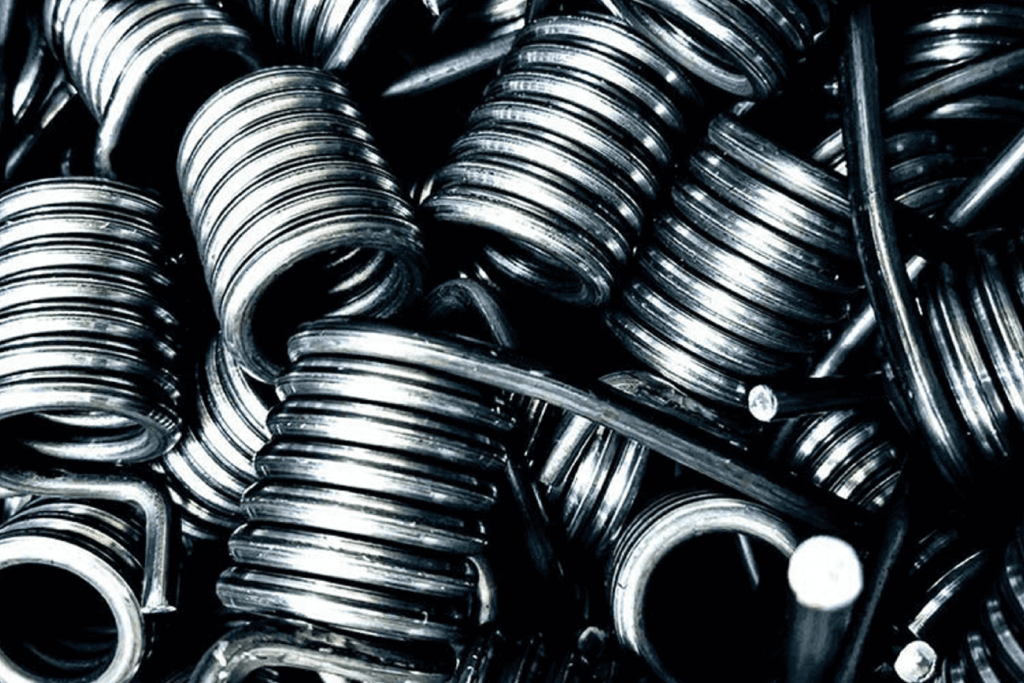
In the design of automotive mechanical systems, torsion springs are components that operate silently but play a crucial technical role. Unlike compression or extension springs, these elements store and release energy through angular movement, making them the ideal solution for mechanisms that require controlled rotational force.
In the automotive industry, torsion springs are found in opening and closing systems, return mechanisms, pedal assemblies, and numerous other applications where a precise and constant torque is required over millions of operating cycles.
At RYPSA, we manufacture torsion springs using in-house engineering and high-performance materials, meeting the industry’s most stringent quality standards.
What is a torsion spring, and how does it work?
A torsion spring is an elastic element that operates along its longitudinal axis: when an angular force is applied to its ends, the spring deforms and stores energy; when that force is released, it returns to its original position, exerting a restoring torque.
This operating principle sets it apart from other types of springs and makes it particularly useful in applications where the following are required:
- Controlled angular return force
- Precise Component Placement
- Resistance to repetitive loading cycles
- Quiet operation of opening and closing mechanisms
The torque generated by the spring depends on the wire diameter, the body diameter, the number of active coils, and the material used—variables that are defined during the engineering phase.
Applications of torsion springs in vehicles.
In the automotive industry, torsion springs are used in a wide variety of vehicle systems.
Among the most representative applications are:
- Return mechanisms in brake and clutch pedals
- Gate and Hatch Opening Systems
- Locking Mechanisms for Latches and Handles
- Retaining Springs in Seat Assemblies
- Adjustment Systems in Steering Columns
- Valve Mechanisms in Engine Systems
In each of these systems, the torsion spring must maintain its rated torque and geometry after millions of operating cycles, without exhibiting permanent deformation or loss of elastic properties.
Critical Design Variables in Torsion Springs
The design of a torsion spring requires consideration of multiple technical variables that determine its performance within the system in which it will operate.
At RYPSA, our in-house engineering team evaluates variables such as:
- Initial torque and required operating torque
- Maximum deflection angle
- Inner diameter for mounting on a shaft or pin
- Length of the spring body in the free position
- Winding direction (right or left)
- Material and heat treatment depending on the application
This analysis makes it possible to design springs that meet the system's functional specifications without compromising the component's service life.
Manufacturing and Quality Control at RYPSA
The manufacture of precision torsion springs requires controlled processes that ensure dimensional consistency and uniform mechanical properties in every batch produced.
At RYPSA, we apply:
- Selection of High-Fatigue-Resistance Steels
- Cold forming with automated dimensional control
- Stress-relief heat treatment
- Verification of torque and working angle by batch
- Dimensional inspection of diameter, pitch, and length
- Statistical Process Control (SPC) in High-Volume Production
Under our IATF 16949 certification, every batch of torsion springs is fully traceable from raw material to finished product.
Conclusion
Torsion springs are technically demanding components that require precise design and controlled manufacturing processes to ensure their performance in critical automotive systems.
At RYPSA, we combine specialized in-house engineering, high-performance materials, and rigorous quality control to manufacture torsion springs that meet the most demanding standards of the global automotive industry.
Continue reading
- Technical Specifications: Springs
- Industry: Automotive